2

I have a plastic case for cello and I would like to install additional rivets like this: this

But first I need to know which kind is this. This was installed on a plastic plate about 1.5mm thick. What is its name and how can I install it? Do I need a drill besides the rivet gun?

Thanks!

LucasBr
  • 129
  • 1
  • What's on the other side? What is it holding to the case? Given the shape and material of the case, a blind rivet gun might be best here so you don't have to bash at the case with a hammer on this awkward curve. You probably don't need an expensive gun ... $20 to $40 online. – jay613 Oct 22 '22 at 14:39
  • @jay613 so $20 to $40, but does that include postage overseas? – Solar Mike Oct 22 '22 at 14:57
  • Good point @SolarMike. It probably costs more where OP lives but he can enjoy better french fries and chocolate after buying it. Seriously though banging a classic rivet into this spot looks like an awkward two-person job. – jay613 Oct 22 '22 at 15:06
  • Do you need a hole in the rivet as the one you've shown seems to be, or is it OK if the center of the rivet is filled in? – FreeMan Oct 24 '22 at 17:47

2 Answers2

4

This is a 'pop rivet'.
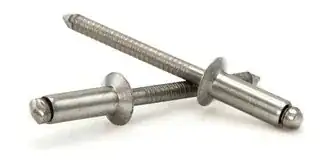
enter image description here
Example from Amazon

You need to drill a hole in your plastic plate that's just large enough for the 'fat' end to fit through, with the shaft sticking out towards you.

You then place a pop rivet gun over the shaft and squeeze the handles (or whatever mechanism your particular gun has) a few times.

This action pulls the shaft of the pop rivet out towards you, and in so doing squashes the body of the rivet up against the inside of the plate you're riveting through. The "nobble" at he end of the shaft is too large to fit through the body of the rivet, and as a result, pulling on the shaft causes the body of the rivet to expand and squash up against the inside of the plate you drilled through.

The shaft is manufactured with a weak spot (not visible in the pic because it's inside the body of the rivet) and once you've squeezed the rivet enough, this weak spot "pops" and most of the shaft pulls out of the hole in the rivet, leaving only the body of the rivet permanently stuck in the hole you drilled.

Pop rivets are made in various lengths, diameters & materials. I've found the most common ones are 3mm or 1/8" in diameter and about 1/2" long (10-15mm). You'll probably want to get ones which are 3-4 times longer than the thickness of the plate you're riveting through, and unless you particularly need extra strength, you should probably choose the aluminum ones rather than steel (in either case the shaft is typically steel, but the body of the rivet could be aluminum).

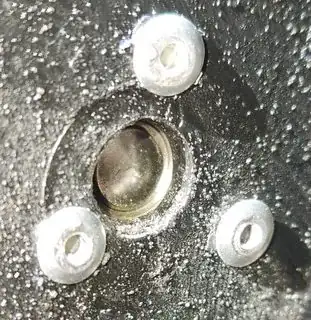
This is a pic of 3 pop rivets I installed this past weekend (they're 1/8" aluminum). In these you can see the remains of the shaft, since they were short rivets in a thin metal sheet. With longer rivets and a thicker material you probably would not see the remains of the shaft in the hole.
enter image description here

isherwood
  • 129,178
  • 7
  • 160
  • 386
brhans
  • 6,263
  • 2
  • 22
  • 36
  • 1
    Every time I've used a pop-rivet, it's left the body inside the rivet, and without a hollow hole. It appears that the OP's got a hollow rivet, though I don't know if that is a requirement of the project. Can the pin with the head be driven out of the rivet leaving it hollow? – FreeMan Oct 24 '22 at 17:46
  • 1
    This is a great explanation. Just as an informational note, POP is a brand name for the rivet invented by Briton Hamilton N. Wylie in the early 1900's. The generic term is "blind rivet" because the rivet can be installed even when the operator is "blind" to the back side of the joint, meaning that the back side can't been seen (is inaccessible). – Greg Hill Oct 24 '22 at 18:54
  • 1
    @FreeMan you can sometimes knock the pin through - it depends on exactly how it got crushed in the other side of the rivet. But even if you don't knock it though, whether or not it's visible would depend on how long the rivet is and where exactly along it the weakened point is where it 'pops'. You can see in the pic I just added that some are more easily visible than others even with 3 "identical" rivets. – brhans Oct 24 '22 at 19:06
0

This looks like a classic rivet, but it could be "blind" - which means the internal pin that pulls the rivet is covered on the inside usually to prevent water ingress.

You will need a drill and a clearance drill bit to make the hole. Be very very careful about how deep you drill once through the case cover.

Solar Mike
  • 26,234
  • 2
  • 28
  • 57
  • 1
    Why very careful? Don't we hope OP opens the case and removes the instrument and any lining before drilling? :) – jay613 Oct 22 '22 at 14:42
  • 1
    @jay613 because it may not be very easy to remove the lining or padding from thr inside without a lot of effort or leaving traces of doing so... – Solar Mike Oct 22 '22 at 14:56
  • 2
    For soft materials (as plastic) one should add an washer on the underside (if possible) – Martin Oct 22 '22 at 20:48
  • @Martin that’s why some rivets are designed with wide heads - such as the one in the image. – Solar Mike Oct 23 '22 at 05:57
  • 2
    I meant the back side, plastic cannot withstand the expanding rivet "tube". In the end OP has only an oversized hole with a loose rivet. To I intended to pinch the plastic between the rivet head and a washer – Martin Oct 23 '22 at 16:50