8

WARNING TO ANYONE READING THIS POST. DO NOT TRY WHAT I WAS PROPOSING AS YOU WILL GET SHOCKED AND KILLED OR YOU WILL BURN DOWN YOUR HOUSE AND BE KILLED.

Is it possible to add indicator lights to a hot water heater to indicate when an element is out? I have searched on the internet and I can't find any related information.

Thank you in advance for any help, Yeto

hot water heater wiring diagram

enter image description here

Would something like this work? The wires from the main panel are connected to the top of the hot water heater and they are already separated approx 6 inches. It would be very easy to clamp around any one of the wires without disconnecting or touching them. Would something like this be the best way to go. I basically just want to turn on the hot water and let it run until the thermostat kicks on the top element and make sure it is pulling approx 18 amps and then when the top clicks off and the bottom kicks on make sure the water heater is still pulling 18 amps.

https://www.aliexpress.us/item/2251832712380385.html?spm=a2g0o.productlist.main.5.1b9678a2ur4ZBn&algo_pvid=6682e15b-b47f-4d9a-8f72-d41cdc57bde7&algo_exp_id=6682e15b-b47f-4d9a-8f72-d41cdc57bde7-2&pdp_ext_f=%7B%22sku_id%22%3A%2266804801259%22%7D&pdp_npi=2%40dis%21USD%2116.22%2111.19%21%21%21%21%21%40211beca116714119047254008d0760%2166804801259%21sea&curPageLogUid=ssyKurB9sY0v

These indicator LEDs should be able to handle voltage without adding a resistor. (I am not going this route as I see now what I was proposing will not be safe. See warning at top.)

https://www.aliexpress.us/item/3256802692000480.html?spm=a2g0o.productlist.main.3.3b5e537cqShRcp&algo_pvid=afac6294-f269-4d2e-9fcf-db66fe20d0a7&algo_exp_id=afac6294-f269-4d2e-9fcf-db66fe20d0a7-1&pdp_ext_f=%7B%22sku_id%22%3A%2212000022591722893%22%7D&pdp_npi=2%40dis%21USD%211.38%210.69%21%21%21%21%21%4021021aa216714658984056757d0773%2112000022591722893%21sea&curPageLogUid=rLF0OYriQMWS

UPDATE

I did it. Found amp probe indicators on Amazon. Work great.

Have pics but don't see where I can add.

Michael Karas
  • 64,093
  • 7
  • 63
  • 142
Yeto
  • 81
  • 3
  • 1
    Do you mean when they burned out/broken or just not turned on? Lights should be simple to show they are working/on, but not working is much different. – crip659 Dec 18 '22 at 15:20
  • Sounds like an XY problem. Water heater elements typically last for several years. Most people probably find out because the water heater isn't heating up the water very well (slow and/or not getting to desired temperature), but it is relatively rare thing - i.e., happens to everyone with an electric heater, but not very often. I could see a manufacture of a new, microprocessor controlled heater adding a couple of indicator lights and, if WiFi connected, sending an alert. Would add very little to cost (though in a very cost-conscious market even that may not make sense). Adding it yourself – manassehkatz-Moving 2 Codidact Dec 18 '22 at 16:52
  • would be far more involved - adding a circuit of some sort to monitor each element but also having to know when the element *should* be on, so monitoring a switch or relay for each element as well, to then produce some sort of output. Just not sure **why**? – manassehkatz-Moving 2 Codidact Dec 18 '22 at 16:53
  • @crip659 I would like to know if thermostat is on and if the element is burned out. – Yeto Dec 18 '22 at 17:01
  • I would try this. Put an LED in parallel with the heater element (as in the lower LED in your diagram). My guess is that the LED will not have enough current to light when power is going to the heater because most of the current will be going thru the low resistance heating element. If the heating element is faulty, it will be an open circuit. Then all the power will go thru the LED. You might have to experiment with a resister in series with the LED to make this work. – Yehuda_NYC Dec 18 '22 at 17:34
  • 1
    the `element OK` LED is shorted by the black wire, it will never light ... the other LED should work as expected, it "sees" the full voltage across the heating element ... the `element ok` LED could be connected across the lower thermostat ... it would light when the thermostat opens and if the element is ok – jsotola Dec 18 '22 at 18:27
  • 2
    If "LED" is a real LED and nothing else, the LED will explode from the high voltage. LEDs need a driver to run from non-LED-compatible power, and power to a heater element is very much not LED-compatible. A neon lamp with current limiting resistor would be a better light, but is not UL listed, and adding it would probably be a violation of something code-ish. – Triplefault Dec 18 '22 at 18:38
  • 2
    This is 240V power. It is dangerous. You should not be doing AC power hacking like this unless you know exactly what you are doing, and even so, you'll void the UL listing on the heater and be in a heap of legal trouble if this shocks someone or causes a fire. There are better ways than conductive... – Harper - Reinstate Monica Dec 18 '22 at 19:59
  • 1
    @Yehuda_NYC sorry, that's wrong. The voltage across the element won't change much regardless of the coil health, the difference limited to a few volts max of upstream copper losses that are induced by the coil's current. Broken or not, one side of the coil has (a bit less than) line voltage and the other side earth voltage. – dandavis Dec 18 '22 at 20:56
  • On our old electric water heater I installed neon indicator lights across both elements (taking care to be sure that the lights were rated for 220V). In normal operation the lights would go on and off with the heating elements. If an element failed the light would remain on constantly. If a thermostat failed "open" the light would be off constantly. – Hot Licks Dec 18 '22 at 23:04
  • @dandavis How is my idea different from that of Hot Licks (that seemed to work). – Yehuda_NYC Dec 19 '22 at 02:03
  • @Yehuda_NYC, 2 things connected in parallel with each other will both see the same voltage at the same time. The current flowing (or not) through one of those things has little to no effect on the current flowing through the other thing. For example your TV may be on the same circuit as your toaster - does your TV turn off when you turn your toaster on? (if it does you have a serious problem with your wiring ...) – brhans Dec 19 '22 at 04:01
  • @Yehuda_NYC the only way HotLick's setup would work is if there were a small leakage current running through the coils 24/7; how else would the lamp get power if the thermostat isn't providing power? I suppose some triacs or SCR's (especially older non-sensitive-gate ones) would pass enough current when off to light an LED or Ne tube. You could feed the coil/LED segment 24/7 with a large resistor, bypassing the thermostat's switching, though I'm not sure how safe of an idea that is. The idea is that the coil eat the limited current, prevents the lamp from lighting while the coil is good+off. – dandavis Dec 19 '22 at 05:12
  • @brhans Of course you are correct, in theory. But if the heater coil is basically zero ohms and the LED is in series with a resister of mega ohms perhaps the LED will not have enough power to light. (Think short circuit.) – Yehuda_NYC Dec 19 '22 at 16:55
  • @Yehuda_NYC - but a heater element is *not* "basically zero ohms" - it has a non-negligible resistance, otherwise it would just trip its circuit breaker . For example a 5kW 240V element is about 11.5 ohms when it's up to its normal operating temperature, and there will still be 240V across both the heater element and the "LED". Assuming the "LED" has a built-in series resistor (for example 47k for a common value), then it'll be drawing about 5mA while the heater it's in parallel with draws about 20.8A. – brhans Dec 19 '22 at 17:02
  • I propose two simpler and safer methods: reading the electric meter (compare kW rating with kW-hr consumed), and temperature of the hot water (electrical kW in ≈ thermal kW out). – Spencer Joplin Dec 19 '22 at 18:41

3 Answers3

10

You're making this way harder than it is.

AC electrical wires throw a considerable magnetic field

in proportion to the current on the wire.

And there's no particular need to detect the amount of current on the wire - 10A vs 20A vs 30A - because resistive heating elements only draw current at one of three rates:

  • 0A
  • design A
  • infinity A, however this does not need to be disambiguated; the circuit breaker will trip and change this to a 0A reading.

Thus we are down to "current or not" as the only thing we need to detect. That's pretty easy. We can do that with magnetic reed switches, or better, Hall Effect sensors.

It simply boils down to finding the right physical places to surveil the wires.
enter image description here

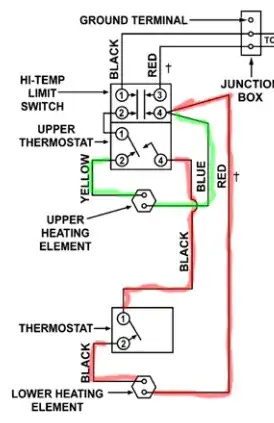
Anywhere along the green for the upper element. Anywhere along the red for the lower element.

Anytime you're trying to sense current, you must remember the golden rule of AC mains wiring: NEC 300.3 all related wires must be kept together in the same cable or conduit, so that currents are equal/opposite in any group of wires, and thus, the magnetic fields thrown by those wires cancel each other out. That is how we avoid eddy current heating, disturbing animals and attuned people, vibration leading to metal fatigue, and other harms. However, if we are trying to detect current, this rule is our enemy.

So we must carefully choose locations where the wire under observation is not next to other wires. Or alternately, twist them like this so the magnetic fields stack.
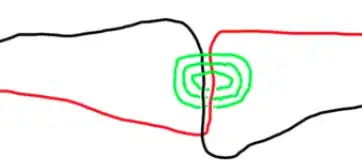
enter image description here

Do not intermix AC mains and low voltage wires

A cardinal rule of AC wiring is that you do not put conductive low voltage wires inside the same enclosure with AC mains wires, and then, have low voltage wires leave the enclosure and go somewhere not protected as well as AC mains wires. So with low voltage you have to create an optical or radio isolation - either keep ALL the low voltage stuff inside the enclosure including its power supply, or keep it all outside the enclosure and use magnetic fields, radio or optics to communicate through the membrane.

Water heaters typically have several access covers. If it were me, I would play with positioning the relevant wires against the access covers to see if the magnetic field will punch through the metal enough to be detected by a Hall Effect sensor (a reed switch is probably too much to hope for lol). Then your installation is neat as a button: all the low voltage DC stuff is on the outside of the steel enclosure and you have achieved separation. Otherwise you might put standard 1/2" knockout holes in the enclosure and filling them with approved plastic knockout covers (generally intended for a Romex cable, but I won't tell lol). One thing or the other should do the trick.

Then it's just Arduinos and Hall Effect sensors, straightforward stuff, the folks over on electronics.se can help with implementation when you get stuck. It's up to you whether to stick a WiFi shield on the Arduino so it can send you email lol.

You may notice that knowing "when the element is on" is slightly different than knowing "when it is supposed to be on". I think you can handle that in software. Just keep track of the last time the element has been seen in use, and alarm if it's been too long.

Harper - Reinstate Monica
  • 295,284
  • 26
  • 275
  • 720
  • You mention "magnetic fields, radio or optics" as if they are all inherently incapable of transmitting high voltage and therefore are safe, but magnetic coupling is how you make a transformer, right? And that could raise *or* lower the voltage compared to mains. I understand the coupling is fairly weak in this application, but you'd need some *principles* to ensure that you don't accidentally create a full-on transformer, right? – nanoman Dec 19 '22 at 10:57
  • Use double insulated wire. There's ***no*** way you're transferring significant voltage or energy with a crude transformer where number of windings is ~1 and there's no iron core. – vidarlo Dec 19 '22 at 15:35
  • @nanoman Well a common 4500W water heater is about 19A, so that's going to limit the magnetic flux unless you start coiling wires, which I do not advise. A straight wire passing through will throw 19 ampere-turns. Also we're only talking about enough energy to trigger a Hall Effect sensor. – Harper - Reinstate Monica Dec 19 '22 at 22:54
4

In the configurations you have drawn, the LEDs will not show if the element has burned out.

The top LED between the thermostat terminal two and the top terminal in the lower element is in parallel with the piece of wire labeled "black" (very low resistance and practically 0 voltage across the wire), so that LED will never light.

The bottom LED is across thermostat terminal two and the bottom terminal in the lower element. It is in parallel with the element, receiving all the voltage coming from the thermostat. It will be lit all the time the thermostat is on, even if the element has burned out. It is wired parallel, just like house wiring, where one light can be off and another on independently.

Additionally, using LEDs alone for this will let the "magic smoke" out of the LED, because 240V AC is staggeringly too much for an LED, which may need 1.5-2 V DC with a current limiting resistor (look on the Electronics Engineering Stack exchange about running LEDs).

You need to read the current going through the wire labeled "black" to determine if the element is running. When the element burns out the current will stop flowing. The safe way to do this is with a clamp ammeter or a current clamp sensor over the "black" wire, along with a sending device that can signal when the current drops below a determined value or to zero. Do a web-search about current sensors for house-voltage-level electricity.

You can put such a sensor on the "yellow" wire also, to sense the top element status.

Triplefault
  • 6,374
  • 1
  • 11
  • 32
1

This can vary depending if you want the light to stay on once a fault as been detected or only while there is a fault. You can build a circuit that detects when the power is turned on to the element or use that to power your circuit. Then if it is not drawing a minimum amount current you light your indicator. This can also be accomplished with a small computer such as an Arduino or Pi. There are many examples of this online. My recommendation is the simplest, purchase and install a current sensor relay.

Gil
  • 6,909
  • 1
  • 5
  • 20