I think there are two very different issues here:
Heat
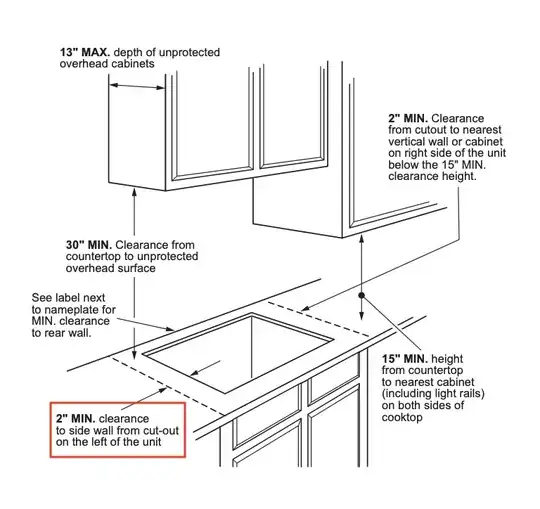
Clearance on sides, back and above are likely based on heat. An induction cooktop can produce a lot of heat. While most of that heat is on top and directed upwards, the rest of the appliance can get hot in use, which is likely the reason for the 2" side clearance. If you don't follow the directions and you ever have a fire, you could find insurance not wanting to pay for damages. Really.
Wiring
Many ovens and cooktops come with an integral junction box. You connect your own wire whip or NM cable or whatever (specs and options vary) to the oven or cooktop and to a junction box.
However, this cooktop comes with an integral 4' conduit. My hunch is that they are seriously concerned about people hooking up too-small cables or trying to set it up as a plug-in/receptacle, both of which can lead to serious problems with an induction cooktop that needs a 50A circuit! A lot of older electric cooktops (and some current models too) use a 20A or 30A circuit. Or even worse, a 40A circuit (more common for a full range = cooktop + oven, than just a cooktop) with a NEMA 14-50 plug/receptacle (so 40A circuit but 50A receptacle which can fool some people into thinking they have a 50A circuit when they don't). In addition to other issues, the larger receptacles tend to have more issues with overheating. So really for almost anything larger than 30A, hardwired is the way to go.
Your average cheap appliance installer (delivery and installation included free on all orders over $x...) will slap a standard plug/cord on an appliance to match the appliance and the existing receptacle. They will not deal with hardwiring - they know that requires an electrician. So they will not attempt to install this thing for you.
Which means that you end up either doing the research (as you are now...) to DIY, or call an electrician. Either way the end result is likely to be:
- Check existing circuit. Breaker 20A or 30A or 40A. Wires not large enough for 50A.
- Run new 50A circuit with 6 AWG copper cable, 8 AWG copper wires/conduit or 8 AWG aluminum wires/conduit.
- Install an appropriate junction box. Which may need to be larger than the previous junction box due to larger wire size.
In order to enforce that, the manufacturer includes a 4' conduit with wires. That way you are far less likely to cheat - doing so would clearly void the warranty. But there is a problem - wire bend radius. 16" is 1/3 of 4'. So with that 16" minimum basically the conduit forms a big loop. With 12" you are more likely to end up with some sharp twists and turns - which is not a good thing.