First, 32A is optional and perhaps unwise.
That's just a default choice handed to you by the manufacturer, by way of giving you a "travel unit" EVSE with the appropriate plug to charge at RV parks (the 50A RV receptacle, often used for 40A ranges).
Cars can actually charge at any rate from 6A to the hardware limit of your car - the car follows a signal from the EVSE ("charger") that tells it the safe amps to draw. The carmaker just didn't toss in gratis the necessary kit to do it. But some automakers will sell you the correct "dongle plug" for any ampacity of charging for not much at all. Or you can use another model of EVSE.
If you're going with a wall unit EVSE, the charge rate is a DIP switch setting.
32A is intended for travel where you need a complete charge overnight, and they give you the RV plug because it's found in RV parks. For daily driving it is overkill, and it's also too much for most house's electrical systems.
Anytime you add a load, you must do a NEC Article 220 Load Calculation e.g. NEC 220.82 alternate method. Whatever headroom remains in the Load Calc, you can charge the car at 80% of that (actual) or 100% of that (breaker).
The vast majority of people can actually get it done on a 240V/20A circuit! (Reddit veteran opening up on the "Giant Charger" crowd). That's 3.8 kW of actual charging, and if you're spending less than 2 hours a day commuting, it'll probably be plenty. It's worth a shot because it's practically free, given the existing stuff in your house.
That socket...
You can't just put a bigger breaker on any random wire. That breaker is 20A for a reason -- that wire is either 20A wire. The breaker protects the wire.
Actually, I'm not confident that it is 20A -- you'll need to find a bit of the sheath that is exposed and see if it says "12 AWG" or "AWG 12" - otherwise it is 14 AWG and that can only take a 15A breaker. One way to find out is get a cheapie 15A receptacle and see if the wire will fit in the backstab hole. If it won't fit, it's 12 AWG wire and you're good to 20A. So you can simply leave the breaker alone.
If it's 15A wire, you'll need to change that breaker to 15A, and I don't think we can dodge the GFCI requirement at that point. Check your state's amendments to NEC 2020 to see if they deleted the requirement.
Installing a new outlet under NEC 2020 will require GFCI protection at the outlet in most locations. However, I would argue this is an incorrect outlet and therefore, replacing it with a NEMA 6-20 is a repair :) which would not invoke the GFCI requirement. EVSEs contain smart GFCIs anyway.
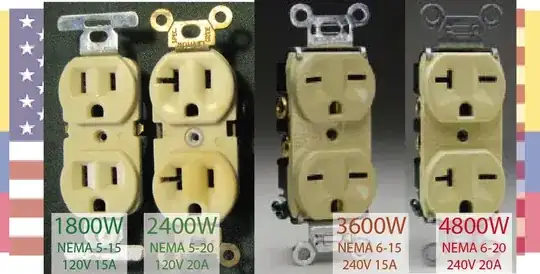
The one on the right.
Install a steel junction box - I would go with a 4x4 steel box with a domed cover.
To get a 20A EVSE
If you are willing to get a wall-mount EVSE and hard-wire it, this is easy. Most of them have DIP switch settings to set the breaker size - make sure your choice does. Though I would be reluctant to buy a non-Tesla wall unit, since the whole industry just changed horses midstream and model year 2025 and on cars will be using the Tesla NACS connector.
If you are using the provided "travel EVSE", contact your manufacturer to see whether they make a NEMA 6-20 dongle for that EVSE. If it's Tesla, they definitely do, and it's $35.
You can also buy inexpensive "travel EVSE's" online - make sure it is UL listed.
Now, this isn't really code legal, but you can use a short cheater cord (NEMA 5-15R on one end, 6-15R on the other end) to plug the provided 120V/15A plug into 240V. Only do this with EVSEs - they are voltage-blind, and will still tell your car to draw 12A - and the car will figure out it's 240V. This will result in better than twice level 1 charging speed.


